Provenance a remote bidder can trust
Record pedigree, exhibition, literature and certification as typed fields on every lot — so a collector who can't be in the saleroom can still see exactly why the piece is what you say it is, and bid like they're standing in the room.
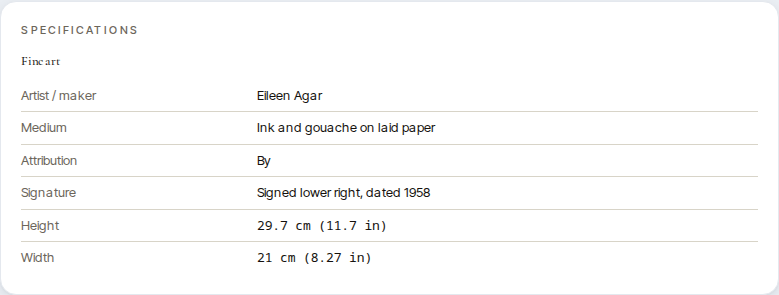
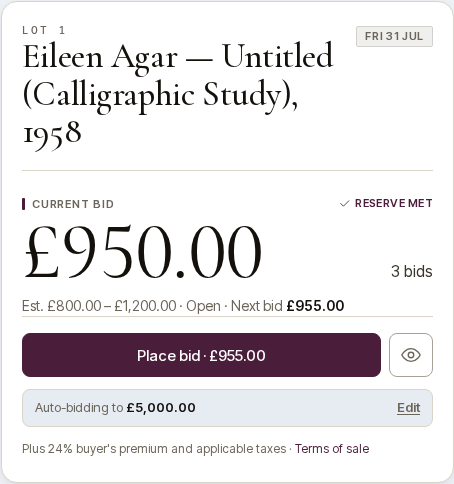
A Bidstrap storefront listing for a works-on-paper lot, showing structured provenance and medium fields beside a live bid panel with the current bid and a Place bid button.
The pain
Half your bidders will never set foot in the saleroom — they're buying a picture they can only see on a screen, from a house they're trusting at a distance. When provenance lives in one free-text paragraph, the careful buyer hesitates, and the lot makes less than it should.
Provenance as four typed fields, not a free-text box
Pedigree, exhibition history, literature and certification each sit in their own typed field — so a collector bidding from a screen can weigh the evidence, not just a seller's paragraph. The same typed history feeds your storefront's structured data, and you add your own fields — condition grade, catalogue raisonné reference, framer's marks — without waiting for a software release.
Live
Evidence on the record, not on faith
Each strand of a lot's history gets its own typed field, so a careful buyer reads the record rather than taking one prose paragraph on trust. This is the gap in auction software where provenance is just another free-text box.
Your own fields, live the same day
Add condition grade, catalogue raisonné reference, medium, dimensions or framer's marks yourself, in settings — no code release, no vendor ticket, no waiting for the next version. The fields you author are typed, not free text.
- Live
Required before the lot goes live
Mark any field your house insists on and the lot can't be published until it's filled — your cataloguing standard enforced by the software, not left to a busy specialist's memory.
Roadmap On the roadmap, and named as such: stolen-art register screening, ARR auto-computation, direct Xero and CRM connectors, templated bidder-list import, the verified-bidder network as it fills, and honest-measurement counting — a design principle the platform is built to, not a count running yet. Everything else on this page is live today.
Everything else your house needs — in your trade's language.
- Live
Your saleroom's own address
Your lots live on your domain — not as a sub-page on a marketplace that ranks instead of you. Every lot ships schema.org structured data: built to be found by Google and citable by the AI assistants dealers now research makers and comparables through.
- Live
One price, and never your bidder's
A take-rate on the hammer that falls as you sell more — never your buyer's premium, and never a fee on your bidders, contractually. No surcharge sprung on a collector's card at checkout for the privilege of finding you, and no quote-only sales call to learn the number.
- Live
Your house, walled off
Every house runs in its own AWS account — your consignor records and bidder details sit behind a wall a shared-tenant platform can't offer. For an AML-supervised house holding identity records, that separation is not a detail.
- Roadmap
Built to count a real bid
Built to count a watch and a bid that mattered — never a card that scrolled past. No 'pageviews' vanity number standing in for genuine interest.
- Roadmap
A verified-bidder network, taking shape
The marketplaces make you rent their audience and tax your bidders to reach it. Bidstrap is building a verified-bidder network where a collector signs in once across member houses as more join — no list leaves your house, and nothing pools into a cross-house directory. Come in early and help seed the pool.
Keep the tools your office already runs on
Connect Xero, your CRM and the rest by signed webhook or CSV export — and watch every delivery succeed, or replay it when it doesn't. Import your back catalogue of lots and assets by CSV today, including from the marketplace you list on now; your contact list stays yours.
Direct Xero & CRM connectors are on the roadmap — webhook and CSV today.
One fair price, on the hammer — never your bidder's premium
You pay the greater of a flat monthly base or a take-rate that falls from 1.0% to 0.5% as you sell more — never both, and only ever on the hammer. Drag the slider and see your exact all-in cost: no email, no sales call, no quote-only wait. We never charge your bidders a fee either — it's a clause in the contract, not a setting. (The monthly base is provisional while we finalise pricing.)
| Hammer band | Rate |
|---|---|
| £0 – £500k | 1.0% |
| £500k – £2M | 0.75% |
| £2M – £20M | 0.5% |
| £20M+ | Bespoke |
Straight answers.
The greater of a flat monthly base or a take-rate on the hammer that falls from 1.0% to 0.5% as you sell more — never both, and never your buyer's premium. The calculator on this page gives you the exact figure with no email and no sales call, and your bidders pay no platform fee by contract. (The monthly base is provisional while we finalise pricing.)
The typed provenance fields and your own custom fields are live today — you author them and mark them required before a lot can publish. What's on the roadmap, and named as such: stolen-art register screening, and direct portal connectors. We won't sell you a roadmap item in the present tense.
Your storefront is your own branded site on your own domain — not a widget bolted into someone else's CMS, and not a sub-page on a marketplace that ranks instead of you. Identity and payment carry a light Bidpass co-brand at the trust moments — the 'log in once, bid safely' mark — but the saleroom is yours, end to end.
Import your lots and assets by CSV today, including your back catalogue from the marketplace you list on now. Your contact list stays yours — there's no cross-house bidder directory, and we never take your consignors or buyers. (A templated bidder-list import is on the roadmap; lot and asset import is live.)
The pack models the decision points so they surface on the right lots — it doesn't make the call for you. It models and supports ARR rather than silently calculating and charging it; it models the AML decision points and leaves the AML decision with you, where the law puts it; and register screening for stolen art is on the roadmap, not something we claim to do today.
Three regional houses, in at the founding rate
Three reference-partner slots — Enterprise, our top plan — at the indicative founding rate for 18 months for a published case study.
Open your saleroom to the collectors who can't attend
Record provenance as fields a remote collector can actually read, on a storefront built to be found under your own name — not buried as a sub-page on a marketplace — and price the whole thing without a sales call. Open an account and catalogue your first sale, or take one of the three reference-partner places while they're open.